 717-533-5154
 Access My Portal
 Pay Your Invoice

A Tax Guide to Choosing the Right Business Entity
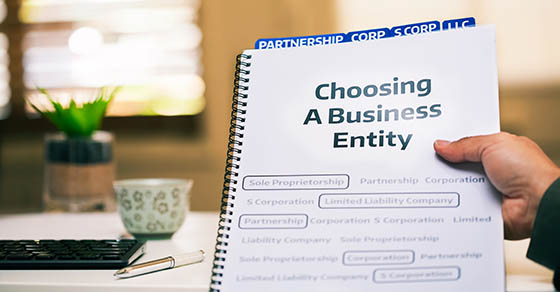
One of the most critical decisions entrepreneurs make when starting or restructuring a business is choosing the right entity type. This choice directly impacts how the business is taxed, the level of administrative complexity and regulatory compliance obligations. While legal liability considerations also matter, we will focus on tax implications. For liability advice, consult a legal professional.
Whether launching a new venture or reassessing your current structure, understanding how each entity is taxed can help you make strategic and compliant decisions. Here’s a brief overview of five entities.
1. Sole proprietorship: Simple with full responsibility
A sole proprietorship is the easiest structure to set up. It’s owned and operated by one person and requires minimal administrative effort. Here are the main features:
- Taxation. Income and losses are reported on the owner’s personal tax return on Schedule C of Form 1040. Income is subject to 15.3% federal self-employment tax, and the business itself isn’t taxed separately. The owner may also qualify for a Qualified Business Income (QBI) deduction, potentially reducing the effective tax rate.
- Compliance. Aside from obtaining necessary licenses or a business name registration, there’s little required paperwork. However, the owner is personally liable for all business debts and legal obligations.
2. S Corporation: Pass-through entity with payroll considerations
An S corp is a tax designation offering pass-through taxation benefits while imposing stricter rules. Here are the highlights:
- Taxation. S corps don’t pay income tax at the entity level. Instead, profits or losses are passed through to shareholders via Schedule K-1 and reported on individual returns. A key tax benefit is that shareholders who are employees receive a salary (subject to payroll tax), while additional profit distributions aren’t subject to self-employment tax. However, the salary must be reasonable. The business is eligible for QBI deductions.
- Compliance. To qualify, S corps must have 100 or fewer shareholders, all U.S. citizens or residents, and only one class of stock. They must file Form 2553, issue annual Schedule K-1s and follow corporate formalities like shareholder meetings and recordkeeping. An informational return (Form 1120-S) is also required.
3. Partnership: Collaborative ownership with pass-through taxation
A partnership involves two or more individuals jointly operating a business. Common types include general partnerships, limited partnerships, and limited liability partnerships (LLPs). Here’s what makes it unique:
- Taxation. Partnerships are pass-through entities. The business files Form 1065 (an informational return), and income or loss is distributed to partners on Schedule K-1. Partners report this on their personal returns. General partners must pay self-employment tax, while limited partners usually don’t. The business is eligible for QBI deductions.
- Compliance. Partnerships require a detailed partnership agreement, coordinated recordkeeping and clear profit-sharing arrangements. While more complex than a sole proprietorship, partnerships offer flexibility for growing businesses.
4. Limited liability company: Flexible and customizable
An LLC merges elements of corporations and partnerships, offering owners — called members — both operational flexibility and liability protection.
- Taxation. By default, a single-member LLC is taxed like a sole proprietorship, and a multimember LLC like a partnership. However, LLCs may elect to be taxed as a C or S corp by filing Form 8832 or Form 2553. This gives owners control over their tax strategies. LLCs that don’t elect C corp status are eligible for QBI deductions.
- Compliance. LLCs require articles of organization and often must have an operating agreement. Though not as complex as corporations, they still generally face state-specific compliance requirements and annual filings.
5. C Corporation: Double taxation with scalability
A C corp is a distinct legal entity offering the most liability protection and growth potential through stock issuance. Here are its features:
- Taxation. C corps face double taxation — the business pays taxes on earnings (currently at a 21% federal rate), and shareholders pay taxes again on dividends. However, C corps can offer deductible benefits (for example, health insurance, retirement plans) and retain earnings without immediately distributing profits. C corps aren’t eligible for QBI deductions.
- Compliance: These entities require the most administrative upkeep, including bylaws, annual meetings, board minutes, and extensive state and federal reporting. C corps are ideal for companies seeking venture capital or IPOs.
After hiring employees
Regardless of entity type, adding employees increases compliance requirements. Businesses must obtain an Employer Identification Number (EIN) and withhold federal and state payroll taxes. Employers also take on added responsibilities related to benefits, tax deposits, and employment law compliance.
What’s right for you?
There’s no universal answer to which entity is best. The right choice depends on your growth goals, ownership structure and financial needs. Tax optimization is a critical factor. For example, an LLC electing S corp status may help minimize self-employment taxes if set up properly. Contact us. We can coordinate with your attorney to ensure your structure supports both your tax strategies and business goals.
© 2025